
In this article
Respond.io's main competitors are SleekFlow (the closest omnichannel match), Wati, Gallabox, AiSensy, Interakt, Zoko, ManyChat and WhatsGrow AI. Which is the right alternative depends on how many channels you actually use: if WhatsApp carries most of your leads, a WhatsApp-first tool is usually cheaper and quicker to run; if you answer customers on four or five channels, SleekFlow is the realistic like-for-like switch.
Below: the eight competitors with who each suits and the starting price we could verify (checked 13 October 2026), then why teams leave respond.io, a worked cost example, and when staying put is the right call. Prices change; every figure links to its source at the end, and we mark any we could not confirm on the vendor's own page.
What are the best respond.io competitors in 2026?
| Tool | Best for | Starting price we verified |
|---|---|---|
| WhatsGrow AI | WhatsApp-first sales teams that want a Kanban pipeline, AI agents, payment links and calling in one tool | 7-day free trial, no card; plans from 3 agents and 1,000 contacts, see pricing for your currency |
| SleekFlow | Teams that need several channels in one inbox (closest to respond.io) | Essential $49/mo billed yearly ($69 monthly), 3 seats; AI agents, broadcasts and flows start on Pro at $109/mo billed yearly (500 contacts included, $20 per extra 100) |
| Wati | Small WhatsApp-only teams that want a simple inbox and a big integration list | Growth $59/mo billed annually ($69 monthly), 3 users (US prices, third-party tracker, September 2026) |
| Gallabox | India and Gulf teams that want AI agents and local-currency billing | Basic Rs. 2,399/mo billed annually (Rs. 2,999 quarterly), 3 users; AI agents start on Essential at Rs. 5,599/mo billed annually |
| AiSensy | Indian teams focused on broadcast campaigns | Free tier; Basic Rs. 1,500/mo (Rs. 1,350 billed yearly) before GST (third-party analysis, 30 September 2026) |
| Interakt | Shopify stores in India | Growth $55/mo plus taxes; separate Sales CRM from Rs. 2,499/mo (Interakt's own page) |
| Zoko | Catalogue and cash-on-delivery stores | Starter $49.99/mo plus $0.015 per conversation markup; AI is a paid add-on |
| ManyChat | Instagram and Messenger DM funnels | Free tier; paid plans priced by contacts. Third-party trackers quote about $15/mo at the smallest tier, which we could not confirm on the official page |
Respond.io itself lists Starter at $79/mo billed yearly ($99 monthly) with 5 users, Growth at $159 yearly ($199 monthly) with 10 users and AI Agents, and Advanced at $279 yearly ($349 monthly). Extra users cost $12 to $24 each, and monthly active contacts are a separate tier with listed overage of $12 per 100 on Growth and $15 per 100 on Advanced.
Meta's WhatsApp message fees are separate on every platform here. Meta bills per delivered template message by category and country, and since 1 October 2026 it also charges for replies inside the 24-hour window after the first 1,000 per number each month. Ask each vendor whether it adds a markup to Meta's rates: only some publish it.
Why do teams leave respond.io?
- The bill has three dials. Plan tier, users above the included seats, and the monthly active contacts tier all move the invoice. A strong ad month can push you into contact overage without any change in team size.
- AI is metered in credits. Starter includes 5,000 credits, Growth 10,000 and up, Advanced 20,000 and up, with extra credits listed at $15 per 1,000. A busier month costs more.
- AI Agents sit on Growth. The cheapest plan does not include them, so an "AI first" setup starts at the second tier.
- WhatsApp-only teams pay for breadth. Respond.io handles WhatsApp, Instagram, Messenger, Telegram, email and web chat. If you use one of them, you fund five.
- Sales tracking is lighter than a deal pipeline. It tracks contacts, lifecycle stages and conversation status; a deal board with values and tasks is something you may add elsewhere.
None of these is a flaw in the product; they are fit questions. The full side-by-side is on the WhatsGrow AI vs respond.io comparison and the respond.io alternatives page.
How does the cost compare for 5 agents and 2,000 contacts?
Example (hypothetical team): five people, about 2,000 contacts messaging per month, and an AI agent answering first-line questions.
- Respond.io: five users fit inside Starter ($79 yearly or $99 monthly), but AI Agents are a Growth feature, so an AI-first setup points to Growth: $159 billed yearly or $199 billed monthly with 10 users included. The contact tier for 2,000 is chosen separately, so confirm the final figure in checkout.
- SleekFlow: AI agents and broadcasts start on Pro at $109/mo billed yearly. That includes 500 contacts; the other 1,500 at $20 per 100 is $300 more, so roughly $409/mo by the published rates (Pro needs the contact add-on at this size).
- WhatsGrow AI: five agents and 2,000 contacts fit the Growth plan limits (10 agents, 25,000 contacts); see pricing for the figure in your currency.
- Wati: Growth allows 3 users with no extra seats, so five agents point to Pro at $119/mo billed annually, which includes 5 users (US prices).
The SleekFlow line shows why to read the contact meter: $109 becomes about $409 at 2,000 active contacts. Add Meta's message fees everywhere. Run your own volumes in the API pricing calculator.
Which respond.io alternative should you choose?
Use these rules, in order:
- Do you really use three or more channels? Yes: SleekFlow, or stay on respond.io. No: continue.
- Is most of your business in India? AiSensy for broadcasts, Interakt for Shopify, Gallabox for AI agents with INR billing. WhatsGrow AI if sales follow-up and payments matter more than broadcasts.
- Do you run cash-on-delivery or catalogue-led sales? Zoko, or WhatsGrow AI's eCommerce pack, which has cart recovery and COD confirmation.
- Are your leads Instagram comments and DMs? ManyChat.
- Do you need deals, tasks, payment links and AI in one place? WhatsGrow AI.
- Is it just a cheap shared inbox? Wati.
For two-way detail on cheaper options, see Wati alternative, AiSensy alternative, Gallabox alternative and Respond.io vs Wati.
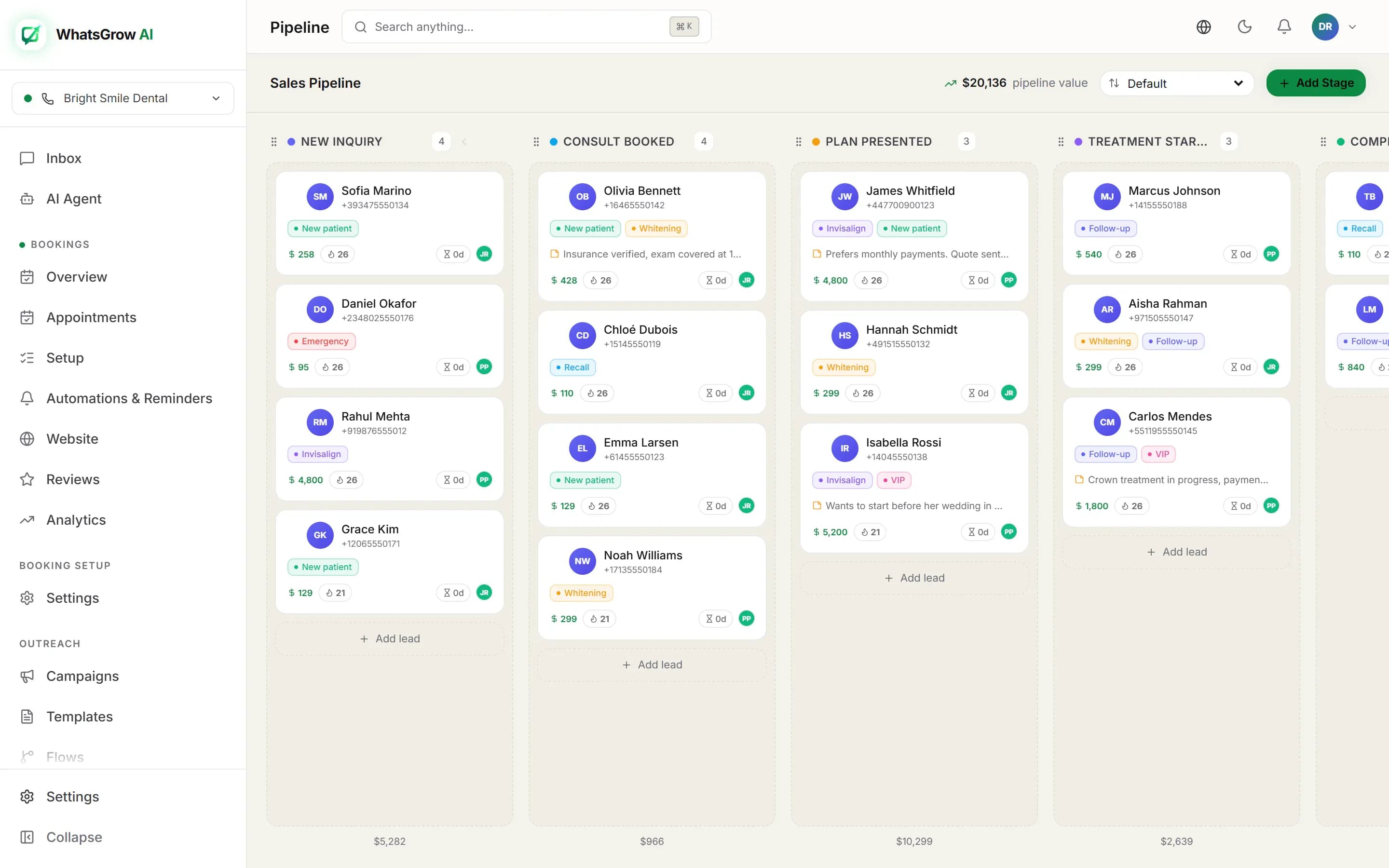
Where does WhatsGrow AI fit as a respond.io alternative?
WhatsGrow AI is WhatsApp only, built on the official Meta WhatsApp Cloud API. What it adds over a pure inbox:
- A Kanban deal pipeline with values, owners and tasks beside the chat (how to design the stages).
- AI agents that answer from a knowledge base, save qualification answers, move deals, create tasks and send payment links, with approval on the risky actions (turn-by-turn guide).
- Stripe and Razorpay payment links inside the chat, and calling through Twilio or RingCentral.
- Separate client workspaces with white-label options for agencies.
- Flat plans with stated agent and contact limits: Starter 3 agents and 1,000 contacts, Growth 10 and 25,000, Pro 50 and 100,000 with a REST API. No monthly-active-contact meter.
What it does not do: Instagram, Messenger, Telegram or email in the same inbox. If you need those, use respond.io or SleekFlow and say so plainly to your team.
When should you stay on respond.io?
Stay if you depend on multiple non-WhatsApp channels, if your contract includes SSO and a custom number of seats, or if your agents are trained on its workflows and routing and the bill is not a problem. Switching costs real hours, and the saving matters only if the invoice hurts.
Consider moving if WhatsApp is around 90 percent of your volume, if contact overage keeps appearing, or if you pay for a separate pipeline and payments tool a WhatsApp CRM could replace. If you move, export contacts with tags and custom fields, reconnect your number through Meta embedded signup (a number can sit on one platform at a time), resubmit templates and run a week in parallel if you can.
What should you ask any respond.io competitor before you switch?
- Is the price per user, per contact, per conversation or flat, and what happens when I pass the limit?
- Which plan includes AI agents and broadcasts, and how are AI credits or resolutions billed?
- Do you add a markup to Meta's per-message rates, and can I see the India, Gulf or Latin America rate sheet in writing?
- How do you handle the 1,000 free service messages per number each month that Meta introduced on 1 October 2026?
- Can I bring my existing WhatsApp number and approved templates, and how long is the cutover?
- What is the real cost of the third and fourth seat?
- Can I export every contact, tag and conversation if I leave?
A vendor that answers these in writing before the sale is usually the one that does so at renewal too.
Sources (checked 13 Oct 2026)
- Respond.io pricing
- SleekFlow pricing
- Wati pricing and Wati pricing explained (third-party tracker, September 2026)
- Gallabox pricing
- AiSensy pricing and AiSensy pricing India 2026 (third-party analysis, 30 September 2026)
- Interakt pricing
- Zoko pricing
- ManyChat pricing (official page blocked automated checks; third-party: eesel.ai)
- Meta: Pricing on the WhatsApp Business Platform