
In this article
Pick QuickReply.ai if you run a Shopify or D2C store and your WhatsApp work is cart recovery, order alerts and COD confirmation. Pick Gallabox if you want an inbox with AI agents and, on its top plan, a lead pipeline that its plan table still marks as coming soon. If most of your revenue conversations are people talking to people, a CRM-first tool such as WhatsGrow AI is a third option worth a trial.
Both vendors publish plan tables. We read both on 17 Oct 2026; details below.
What is the difference between Gallabox and QuickReply.ai?
QuickReply.ai is store-shaped: cart recovery, order alerts, COD flows and contact-level conversion reporting. Gallabox is inbox-first: WhatsApp, Instagram and a web widget, with AI agents and calling on higher plans. They overlap on the basics, WhatsApp Business API, broadcasts, bots and a shared inbox, but start from different places.
QuickReply.ai calls itself a WhatsApp automation platform built to make marketing spend count. Its feature list is store-shaped: abandoned cart and checkout reminders, order alerts, COD confirmation, COD-to-prepaid nudges, repeat-purchase reminders, click-to-WhatsApp ads, a commerce catalog and payment collection. It reports reads, clicks and conversions at contact level and shows ROAS.
Gallabox is an India-based inbox-first platform covering WhatsApp, Instagram and a web widget. Its plans climb from a 3-user inbox with chatbot flows, to AI agents and calling, to a lead pipeline, appointment booking and AI voice. Shopify is one of its integrations from the entry plan, but it is a feature of the tool, not the point of it.
Gallabox vs QuickReply.ai: pricing compared
Both vendors publish plan tables, and seats decide the real cost. QuickReply.ai Starter is $39 a month billed yearly for 1 login; Gallabox Basic is Rs. 2,399 a month billed annually, capped at 3 users. A 5-person team needs QuickReply.ai Plus or extra agents, or Gallabox Essential or higher.
| QuickReply.ai | Gallabox | |
|---|---|---|
| Entry plan | Starter from $39/mo on annual billing ($59 on the quarterly toggle), 1 agent login | Basic: Rs. 2,399/mo billed annually (Rs. 2,999 quarterly), 3 users hard cap, 500 AI credits |
| Mid plan | Standard from $99/mo annual ($149 quarterly), 2 logins | Essential: Rs. 5,599/mo annual (Rs. 6,999 quarterly), 6 users, 2,000 AI credits |
| Upper plan | Plus from $199/mo annual ($299 quarterly), 5 logins | Advanced: Rs. 13,599/mo annual (Rs. 16,999 quarterly), 10 users, 8,000 AI credits |
| Extra seats | $10 per agent per month on all plans | Essential and Advanced allow extra users, charged monthly; Basic is capped |
| Contacts | Monthly active contacts listed as unlimited on Starter, Standard and Plus | Not stated in the plan summary; users and AI credits are the listed limits |
| Taxes and Meta fees | Taxes extra; messaging charges extra | Meta fee markup not stated for Basic to Advanced on the page |
QuickReply.ai prices are the USD view of its pricing page, labelled "starting from". Gallabox prices are the INR price book. When we opened Gallabox's page in USD, the same plans showed as $112, $248 and $474 a month billed annually, which is far above a straight currency conversion, so compare in the currency you will actually pay. Seat arithmetic matters more than the entry price: a 5-person team cannot use Gallabox Basic at all, and on QuickReply.ai needs Plus or extra agents.
Which has the better Shopify integration?
For a Shopify store, QuickReply.ai is the more specialised pick. Cart and checkout abandonment, order alerts, COD confirmation and feedback collection are named plan features, and it has a Shopify integration with reviews from Shopify merchants. Higher plans add product-browsing and add-to-cart abandonment with reminders.
Gallabox lists Shopify in its Basic-plan integrations alongside Razorpay, Stripe, Cashfree and Shiprocket, and it lists catalog and payments from Basic. That covers order notifications and commerce chat. The exact abandonment and COD scenarios are what to test in a trial, because Gallabox's page does not enumerate them the way QuickReply.ai's does.
If Shopify cart recovery is more than 80 percent of what you will do, this one row decides it. QuickReply.ai.
Flows, AI and bots: how do they compare?
QuickReply.ai. Starter lists no bots. Standard adds WhatsApp bots and keyword-based response; Plus adds WhatsApp flows and white-glove service, and lists custom chatbot setups as an add-on. The site describes a no-code AI builder that can use CRM data and hand off to a human, and its feature table lists NLP-based training on Plus only.
Gallabox. Chatbot flows are on Basic. AI agents on WhatsApp and Instagram start at Essential, human calling on WhatsApp too, and AI voice on WhatsApp and phone sits on Advanced. AI runs on monthly credits (500, 2,000, 8,000), which is a metered cost to watch.
For a team that wants an AI to answer from a price list at 11 pm, Gallabox has the clearer AI story. QuickReply.ai's strength is the scripted, trigger-based journey.
CRM pipeline and campaign analytics
Neither is a CRM first. QuickReply.ai syncs one way to your CRM on Standard and two ways on Plus, with Zoho, HubSpot, LeadSquared and Salesforce integrations, so your pipeline lives elsewhere. Gallabox lists a lead pipeline on Advanced, but its comparison table marks it coming soon. On analytics, QuickReply.ai suits ads-driven stores and Gallabox suits conversation and bot reporting.
The detail:
Gallabox lists lead pipeline management on Advanced, but its comparison table still marks the pipeline and appointment management as coming soon. Bi-directional CRM integrations start on Essential. Its analytics list covers conversation, broadcast, sequence, bot and template analytics.
On campaign reporting, QuickReply.ai's contact-level conversion and ROAS view suits an ads-driven store. Gallabox's analytics suits a team measuring conversations and bot outcomes.
Which one fits whom?
Pick QuickReply.ai for a Shopify store where cart recovery and COD flows are the job. Pick Gallabox Essential for a 3-to-6-person service team that wants AI agents on WhatsApp and Instagram. Pick a CRM-first tool when a sales team must see deals by stage, assigned per agent.
| Your situation | Better fit |
|---|---|
| Shopify store, 1 to 2 people, cart and COD flows are the job | QuickReply.ai |
| Service business in India, 3 to 6 people, wants AI agents on WhatsApp and Instagram | Gallabox Essential |
| Wants a published support SLA and local India onboarding | Gallabox |
| Needs unlimited contacts without a per-contact meter | QuickReply.ai |
| Sales team that must see deals by stage, assigned per agent | A CRM-first tool; check that Gallabox's pipeline is live before you rely on it |
A real-world version: a D2C skincare brand with 20,000 monthly orders and two support agents lives in QuickReply.ai flows. A three-clinic dental group booking consultations from Instagram and WhatsApp wants Gallabox Essential or Advanced for the appointment and AI features. A real-estate team of four chasing 300 Meta-ad leads a month wants neither as its main system.
Where does WhatsGrow AI fit as a third option?
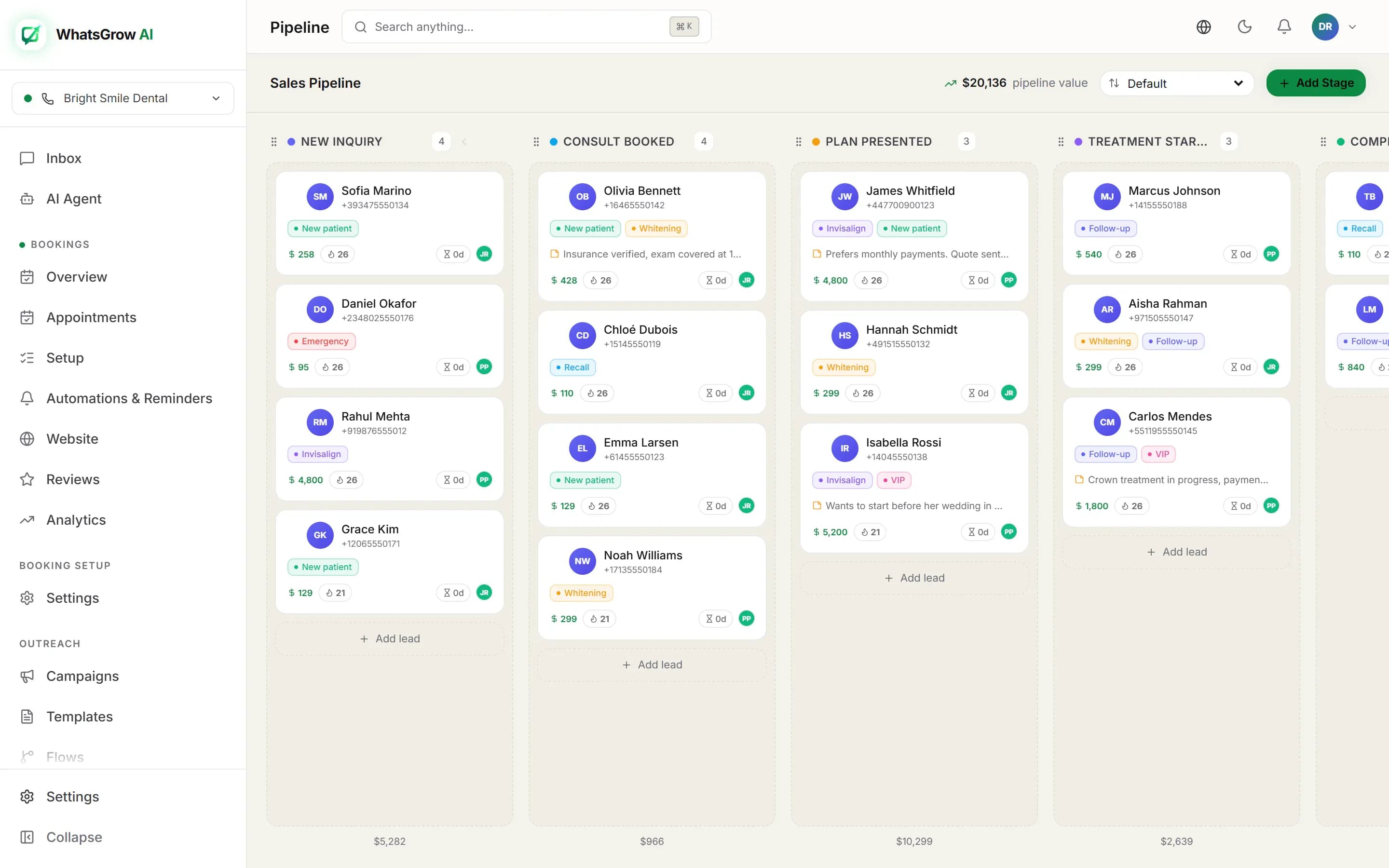
WhatsGrow AI suits the team between those two: people close deals in WhatsApp and the owner needs a pipeline. Every plan includes a Kanban pipeline with values, assignment and tasks, and AI agents that update fields, move stages and send payment links. The trial is 7 days, no card.
Pipelines: 1 on Starter, 5 on Growth, 20 on Pro. Agents answer from your knowledge base on Growth and above. Limits are flat: Starter 3 agents and 1,000 contacts, Growth 10 agents and 25,000 contacts, Pro 50 agents and 100,000 contacts. See pricing in your currency on /pricing; the trial is 7 days, no card.
Be realistic about the gaps. WhatsGrow AI is WhatsApp-first, with Instagram and Messenger in limited access, so Gallabox's Instagram inbox is a point in its favour. It has a store connection screen for Shopify and WooCommerce, but it is not a dedicated cart-recovery product, so test your abandonment and COD flows in a trial before you rely on it for that.
More detail: WhatsGrow AI vs Gallabox, Gallabox alternatives and the WhatsApp CRM pipeline.
Worked example: 3 agents and a 10,000-contact list
A 3-agent store with a 10,000-contact list lands on Standard or Plus at QuickReply.ai, or Basic or Essential at Gallabox. Seat count sets the floor and the feature you need sets the plan. The example is a home-furnishing store with 3 support and sales agents and a mix of order updates, broadcast offers and customer chats.
- QuickReply.ai: Starter includes 1 login and Standard includes 2, so 3 agents means Plus (5 logins) or Standard plus one extra agent at $10 a month. Contacts are listed as unlimited, so list size does not push you up a plan. New accounts start at 1,000 messages a day, rising to 10,000 and then 100,000 a day as you use the limit.
- Gallabox: Basic fits exactly 3 users, but a fourth hire is blocked. Essential gives 6 users and brings AI agents, calling and drip campaigns, which is probably what a growing team wants anyway. Its messaging rate limit climbs by plan (100 messages a minute on Basic, 200 on Essential, 1,000 on Advanced).
So the 3-agent store lands on Standard or Plus at QuickReply.ai, or Basic or Essential at Gallabox. The cheaper line item is rarely the cheaper outcome: price the plan that has the feature you actually need (bots, flows, AI agents) rather than the one that merely fits the seat count. Add Meta's per-template fees and tax on both.
What to test in a free trial
Test behaviour, not checkboxes: run one real abandoned-cart or enquiry flow end to end, hand a chat from the bot to a human, read the campaign report, get the Meta fee in writing and check how long the trial really runs. The five checks below fit into a week on a real number.
- Send one real abandoned-cart or enquiry flow end to end. Count how many steps a setup takes and whether the trigger fires reliably.
- Hand a chat from the bot to a human. Check the agent sees the history and can take over without the customer repeating themselves.
- Read the campaign report. Can you tell which message produced which order or booking?
- Ask for the Meta fee in writing. Neither page states a markup you can budget from for every plan.
- Check the trial itself. Gallabox offers a free trial with 500 AI credits and no card, and does not state how long it runs on its page. QuickReply.ai's pricing page does not mention a trial, only demos, so ask.
WhatsGrow AI is the odd one out here: its trial is 7 days, no card, which is enough time to run all five checks on a real number.