
In this article
If you are here because Zixflow is more messaging engine than sales tool for your team, the shortlist is simple. For human sales teams working leads in WhatsApp, look at WhatsGrow AI, Gallabox or respond.io. For a cheap shared inbox in India, Gallabox, Interakt or AiSensy. Stay on Zixflow if your real job is cross-channel lifecycle messaging (WhatsApp, SMS, email, push) triggered by product events.
A caveat up front: Zixflow's own pricing page shows no plan table and sends you to book a demo (checked 17 Oct 2026), so every price below is for the alternatives, not for Zixflow.
What is Zixflow, and what does it actually do now?
Zixflow describes itself as a customer engagement platform: Sendflow for API-triggered message flows with fallback to another channel, AudienceIQ for real-time user profiles, Threads for an AI reply agent, plus Engage+ and Broadcast. Live channels are WhatsApp, RCS, SMS, email and push; Instagram, web push and in-app are marked soon.
Two things the homepage does not say. It does not call itself a CRM or show a sales pipeline, and although it pictures an inbox and an AI reply agent (Threads), it describes no team workflow around them. Older write-ups, including our Gallabox vs Zixflow comparison, treated it as a multichannel CRM. If you signed up expecting a Kanban deal board and an inbox your closers live in, that mismatch is the most common reason people start searching for an alternative.
On price, the pricing page has no plan table and sends you to a demo booking. Third-party listings show older, conflicting entry prices, so we have not repeated any of them. Get a written quote.
Why do teams look for a Zixflow alternative?
Teams usually leave because the work is conversations, not journeys: they need assignment, follow-up and a pipeline more than an event-triggered flow engine. Two other reasons recur, no public price to budget from and paying for channels they never use. Three patterns show up with teams that run sales on WhatsApp:
- The work is conversations, not journeys. A 4-agent real-estate team in Dubai getting 300 leads a month from Meta ads does not need an event-triggered flow engine first. It needs every enquiry assigned within a minute, a follow-up that does not get forgotten, and a pipeline that shows which viewings are booked.
- No public price. Budgeting is hard when you can only get a number after a demo. Several alternatives publish plan tables.
- Channel sprawl you do not use. If 95 percent of your revenue conversations happen on WhatsApp, paying for RCS and push tooling is overhead.
None of that makes Zixflow bad. It makes it a different tool from the one you may have wanted.
Which Zixflow alternatives are worth a trial?
For human sales teams working leads in WhatsApp, trial WhatsGrow AI, Gallabox or respond.io. For a cheap shared inbox in India, trial Gallabox, Interakt or AiSensy. Wati suits small teams that want a simple, well-known inbox. The table gives each tool's best fit, entry price and catch.
| Tool | Best for | Starting price and billing basis | The catch |
|---|---|---|---|
| WhatsGrow AI | WhatsApp-first sales teams that want inbox, AI agents and a Kanban pipeline in one place | Starter: 3 agents, 1,000 contacts. 7-day free trial, no card. See pricing in your currency on /pricing | WhatsApp-first: email and SMS connect, Instagram and Messenger are in limited access, no RCS or push |
| Gallabox | India-based teams that want WhatsApp plus Instagram and a local support team | Basic Rs. 2,399/mo billed annually (Rs. 2,999 quarterly), 3 users hard cap | Lead pipeline is listed on Advanced, but its comparison table marks it coming soon |
| Interakt | Shopify and D2C brands in India | Growth $55/mo plus taxes; Starter covers one channel at $69 a quarter | Sales CRM is a separate product (Rs. 2,499/mo, 5 agents); AI agents are an add-on |
| Wati | Small teams that want a well-known, simple WhatsApp inbox | Growth $39/mo billed yearly, $49 monthly, 3 users, no extra users allowed (Wati page, Pakistan view; Wati prices by country) | Per-seat fees from Pro; message charges follow Wati's own rate card |
| AiSensy | Broadcast-heavy teams in India on a tight budget | Basic Rs. 1,500/mo billed monthly (Rs. 1,350 yearly), owner plus 5 agents, before GST | Chatbot builder (Rs. 2,500/mo) and AI agent (Rs. 1,350/mo) are paid add-ons |
| respond.io | Multi-channel support and sales teams with a bigger budget | Starter $79/mo billed yearly, $99 monthly, 5 users | Unlimited contacts on Starter, then monthly-active-contact tiers from Growth; AI Agents start on Growth at $159/mo yearly |
Prices come from each vendor's own pricing page, checked 17 Oct 2026. WhatsApp message fees are billed by Meta or marked up by the platform in every case, so they sit on top. Ask each vendor for its rate card in writing.
How do the alternatives fit a real team?
Test the shortlist against a real team, not a feature grid. Seat caps and where the pipeline sits decide the choice more than the headline price. Here is a 4-agent Dubai property team getting 300 Meta-ad leads a month, qualifying buyers in English and Arabic, with an owner who wants stages like viewing booked and offer sent.
- Wati Growth is out. It caps at 3 users with no extras allowed. Pro works, at a higher price.
- Gallabox Basic is out for the same reason (3-user hard cap). Essential covers 6 users, and the pipeline is listed on Advanced, though its comparison table marks it coming soon.
- AiSensy covers the seats, but you add the chatbot and AI-agent add-ons to get what the others bundle.
- respond.io handles the team size (5 users on Starter); the cost is the question, especially as monthly active contacts grow.
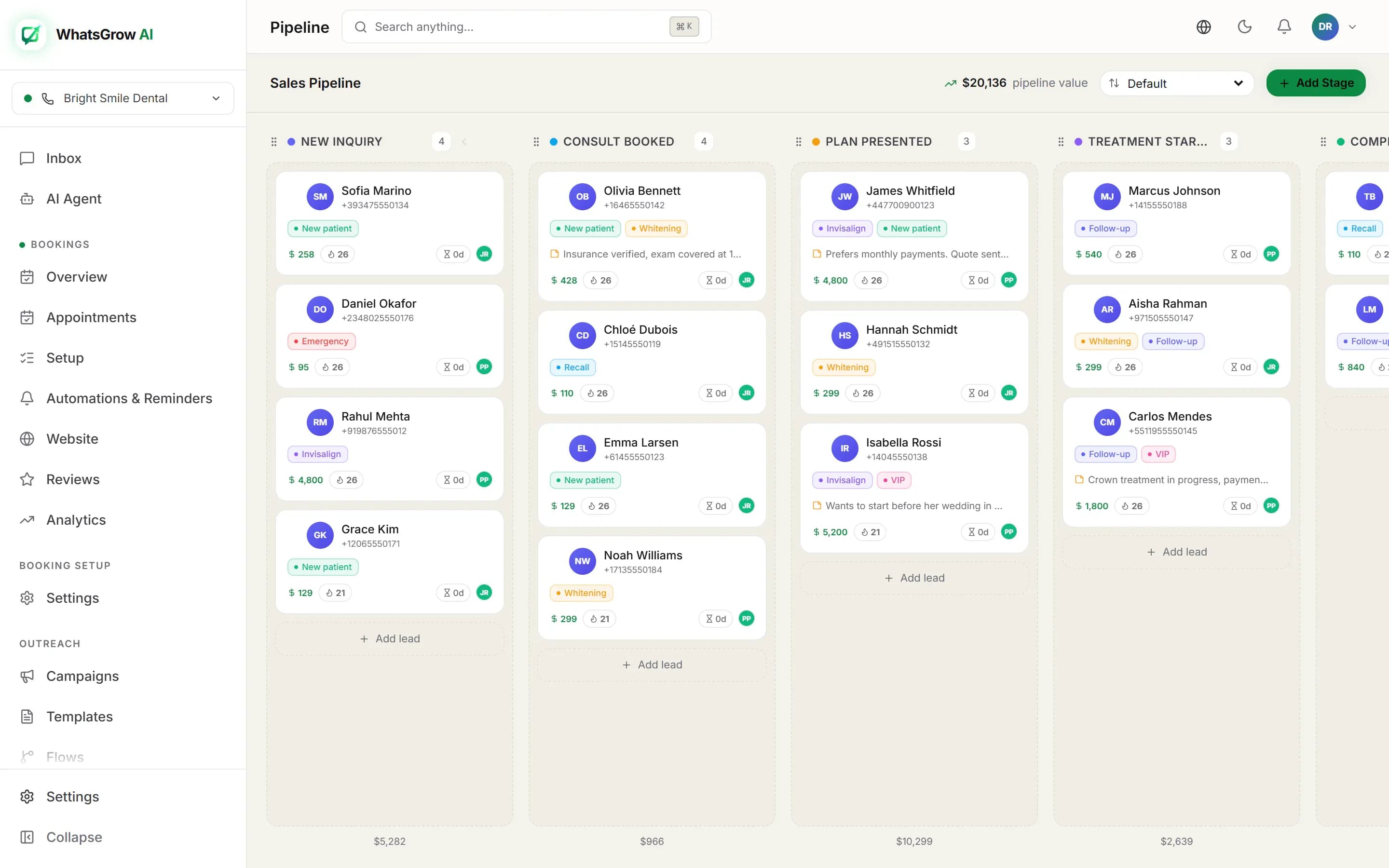
- WhatsGrow AI Growth gives 10 agents, 25,000 contacts, the AI knowledge base, payments and a Kanban pipeline with deal values and assignment. See the WhatsApp CRM pipeline and the AI agent for what that looks like. Language coverage includes Arabic, Hindi and Urdu.
Flip the scenario. A 2-person Indian D2C brand sending order updates and cart reminders needs none of that. Interakt or AiSensy is the more sensible, cheaper pick.
Zixflow vs WhatsGrow AI: where does each win?
Zixflow wins when messaging is triggered by software, not by people. OTPs, onboarding sequences, win-back campaigns that fall back from WhatsApp to SMS to email, per-user profiles built from product events: that is its territory, and WhatsGrow AI does not try to be it.
WhatsGrow AI wins when a human closes the deal. The inbox, tasks, pipeline stages, payment links (Stripe and Razorpay) and an AI agent that qualifies the lead and updates the CRM fields all live in the same screen. Agencies on the Enterprise plan can run separate client workspaces. Limits are flat by plan: Starter 3 agents and 1,000 contacts, Growth 10 agents and 25,000 contacts, Pro 50 agents and 100,000 contacts, with API keys and webhooks from Growth.
For a head-to-head with a closer competitor, see WhatsGrow AI vs Gallabox and WhatsGrow AI vs Wati.
When should you stay on Zixflow?
Stay on Zixflow when software triggers your messages rather than people answering them: most volume is automated journeys and alerts, you need several channels in one flow, developers own the setup, or your sales team already works in another CRM. If any of the four below is true, the gaps above matter much less.
- You send more than you converse. Most of your volume is automated journeys and transactional alerts, and agents rarely reply by hand.
- You need channels beyond WhatsApp in one flow, such as RCS, SMS, email and push with automatic fallback.
- Developers own the setup. You trigger messages through the API and SDKs and want audience profiles built from events.
- You already have a CRM. Your sales team works in another tool and Zixflow only runs the messaging.
A quick test before you move: count how many conversations last week a human actually answered. If it is most of them, you are using a messaging engine as a sales desk.
How to run the trial properly
Use one week of real traffic, not a demo script, and move one number or lead source. Check four things: how fast a new enquiry is assigned, whether the AI answers from your price list without inventing figures, whether a lead moves through stages inside the inbox, and what the invoice looks like once Meta's fees are added.
WhatsGrow AI's trial is 7 days with no card, so you can run this test without a procurement call (see the pricing page for plans in your currency). For the wider field, our ranking of the best WhatsApp CRMs covers eight tools.
What should you ask before you switch?
Ask every vendor six things in writing before you move a live number: how the number migrates, whether templates must be resubmitted, the real per-message fee, seat and contact caps, what you can export, and support hours. Switching WhatsApp tools is mostly a Meta exercise, and the surprises sit in these details.
The questions in full:
- Number migration. A WhatsApp Business number sits on one platform at a time. Ask how the cutover works and how long the number is offline. Plan it for a quiet hour, not Monday morning.
- Templates. Approved templates generally have to be resubmitted in the new workspace. List your five most-used ones now.
- The real message fee. Meta charges per delivered template message. Some vendors add a markup; ask for the rate card for your countries, not the headline plan price.
- Seat and contact caps. Hard caps, such as Gallabox Basic's 3 users or Wati Growth's no-extra-users rule, force an upgrade the day you hire.
- Export. Ask whether you can export contacts, tags, custom fields and conversation history as CSV, and test it on day one.
- Support hours. If your leads message at 9 pm Gulf time or 10 pm Karachi time, a support team that sleeps then matters more than a feature list.
The vendors above that publish a plan table make this easy. A vendor that only offers a demo call is not disqualified, but you are negotiating blind until you see a written quote.