
In this article
Twilio charges $0.005 for every WhatsApp message it handles, inbound or outbound, on top of whatever Meta bills for the message itself. On a utility template to India that makes Twilio's fee about 3.6 times Meta's. On a marketing template to the UAE it adds about 9 percent. The fee is flat, so the rest of this page works out when it matters and when it does not.
Every number below was read from Twilio's and Meta's own pages on 16 and 17 Oct 2026. Where a page was silent, we say so.
How much does Twilio charge for WhatsApp messages?
Twilio's WhatsApp page, labelled "current as of September 2026", lists a handling fee of $0.005 per message, inbound or outbound, plus Meta's per-message fee passed through. Failed messages carry a separate $0.001 fee. That is the whole base price: no seat fee and no monthly platform fee on the page.
Three details change the arithmetic:
- Inbound counts. Meta never charges you for a message a customer sends. Twilio does, so a chat where the customer writes 6 times costs $0.03 in Twilio fees before you have replied once.
- The fee is flat across categories and countries. Marketing, utility, authentication and service messages all carry the same $0.005. That is why the fee looks small on expensive marketing sends and large on cheap utility sends.
- Add-ons cost extra. Twilio lists a Messaging Engagement Suite (link shortening, click tracking, message scheduling) at $0.015 per message, with the first 1,000 free each month.
Twilio is an API, not an inbox. The $0.005 buys one API across Twilio's channels. A shared inbox for agents, a lead pipeline and AI replies are things you build or buy separately.
What does Meta add on top of Twilio's fee?
Meta bills every delivered message by category and recipient country, and Twilio passes that charge through. Since 1 Oct 2026, service messages (free-form replies in the 24-hour window) are charged after the first 1,000 per number each month, and utility templates in an open window are charged too.
Here is Meta's USD rate card for six markets, with Twilio's flat fee shown as a percentage of Meta's rate:
| Market | Meta marketing | Meta utility / service | Twilio $0.005 as % of marketing | Twilio $0.005 as % of utility |
|---|---|---|---|---|
| India | $0.0118 | $0.0014 | 42% | 357% |
| Pakistan | $0.0473 | $0.015 | 11% | 33% |
| United Arab Emirates | $0.0576 | $0.0157 | 9% | 32% |
| Malaysia | $0.086 | $0.014 | 6% | 36% |
| Brazil | $0.0625 | $0.0068 | 8% | 74% |
| Mexico | $0.0397 | $0.0085 | 13% | 59% |
The pattern is plain. Twilio's fee is a small add-on to marketing sends in the Gulf or Southeast Asia and a multiple of Meta's own fee on cheap utility traffic in India or Brazil. Country detail: India, Pakistan, the UAE and Malaysia.
One more Meta rule matters. When a customer taps a Click-to-WhatsApp ad on the mobile app and you reply within 24 hours, Meta opens a free entry point window that can last up to 7 days, during which it does not charge for marketing, utility, authentication or service messages. Twilio's page carves no exception out of its $0.005 fee for those messages, so ask Twilio in writing whether the fee still applies inside the window.
What does a real month cost through Twilio?
A Dubai clinic that sends 2,000 utility and 500 marketing templates and answers 1,500 patient messages pays $95.55 a month through Twilio: $68.05 to Meta and $27.50 to Twilio. Twilio's share is 40 percent on top of Meta's bill. The working is below.
The clinic uses one WhatsApp number. In a month it sends 2,000 appointment reminders (utility templates) and 500 promotional templates (marketing), receives 1,500 messages from patients and sends 1,500 free-form replies.
| Line | Volume | Rate | Cost |
|---|---|---|---|
| Meta utility | 2,000 | $0.0157 | $31.40 |
| Meta marketing | 500 | $0.0576 | $28.80 |
| Meta service replies | 1,500, of which 1,000 free | $0.0157 on 500 | $7.85 |
| Meta subtotal | $68.05 | ||
| Twilio fee, outbound | 4,000 | $0.005 | $20.00 |
| Twilio fee, inbound | 1,500 | $0.005 | $7.50 |
| Total | $95.55 |
Twilio's fee is $27.50, which is 40 percent on top of Meta's bill. Two caveats. Twilio's page does not say whether the 1,000 free service messages are passed through, so in the worst case the Meta side rises by $15.70 and the total is $111.25. And the total excludes everything you must build around the API: a place for staff to read and answer chats.
Now flip the traffic. An Indian online store sends 20,000 order updates a month, all utility. Meta bills 20,000 x $0.0014 = $28. Twilio's fee is 20,000 x $0.005 = $100. The total is $128, of which 78 percent is Twilio. That is the profile where the flat fee hurts.
When is Twilio still the right choice?
Twilio is the right choice when engineering time, not message fees, is your main cost, or when WhatsApp is one channel of several that you want behind a single API and invoice. The per-message fee pays for that convenience, and for many teams it is worth it.
- A developer team already runs on Twilio. If SMS, voice and verification already go through Twilio, adding WhatsApp is the same SDK, the same console and the same bill.
- Low volume of high-value messages. At 2,000 messages a month the Twilio fee is $10. Nobody should re-platform to save $10.
- You need channel fallback in code. Sending a WhatsApp message and falling back to SMS when it fails is a few lines of logic against one API.
- Procurement wants an established vendor. Large companies often prefer one contract with a recognised CPaaS over several smaller ones.
If none of those describe you, keep reading.
When is a direct Cloud API platform cheaper?
A direct Cloud API platform is cheaper when you handle a lot of messages, because it swaps Twilio's per-message fee for a flat plan and bills Meta's fee to your own Meta account. The break-even is simple: Twilio costs $0.005 times every message in and out, so a flat plan wins once that passes its price.
| Monthly messages (in + out) | Twilio handling fee |
|---|---|
| 5,000 | $25 |
| 20,000 | $100 |
| 50,000 | $250 |
| 100,000 | $500 |
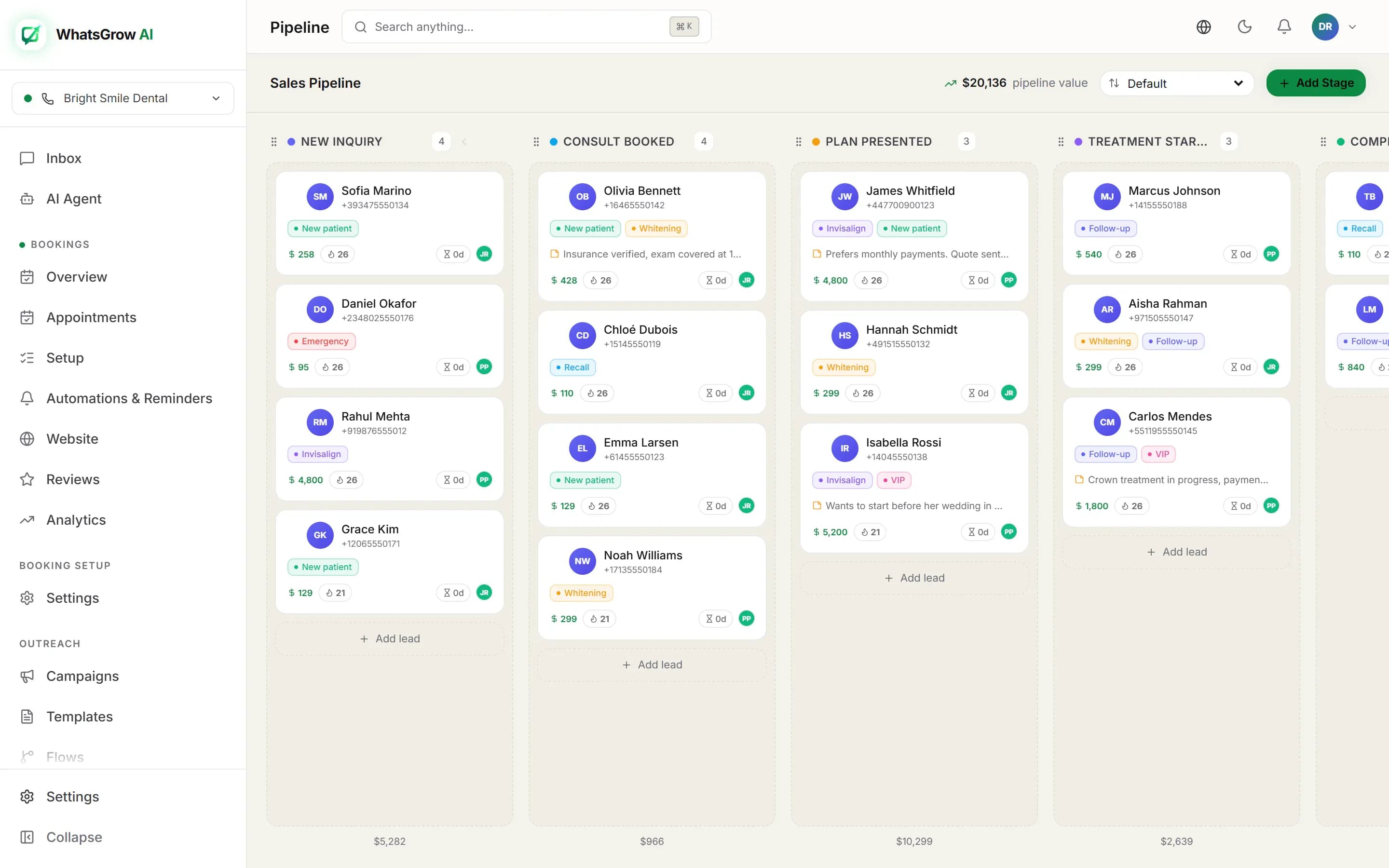
The fee scales with chatty conversations, so a support team answering long threads crosses the line quickly. For what a flat plan can include, compare a platform that ships an inbox: WhatsGrow AI connects your number through Meta's Cloud API, bills Meta's message fees to your own Meta account with no markup from us, and includes the shared inbox, a Kanban pipeline and an AI agent in the plan. See /pricing for plans in your currency.
Do not assume every platform is markup-free. Zoko's pricing page, for example, lists a $0.015 per conversation markup on its $49.99 Starter plan, and Wati's page says message charges follow the Wati rate card. For the full field see the best WhatsApp CRM software, and for the setup steps how to set up the WhatsApp Business API. To model your own volume, use the WhatsApp API pricing calculator.
What should you ask any provider before signing?
Ask four things in writing: whether a per-message fee applies to inbound messages, whether Meta's fee is passed through at cost, whether the 1,000 free monthly service messages reach your invoice, and what leaving costs. Those four explain most of the gap between quotes, whether the provider is Twilio or anyone else.
The full list before you move a live number:
- Is there a per-message fee, and does it apply to inbound messages? This single question explains most of the gap between quotes.
- Is Meta's fee passed through at cost? Ask for the markup, if any, per category and country.
- Are the 1,000 free monthly service messages passed through? Meta grants them per business phone number; confirm they reach your invoice.
- Does the provider charge during a free entry point window? Meta does not, so a provider fee there is pure margin.
- What do failed and undelivered messages cost? Twilio charges $0.001 on Failed ones; others charge nothing.
- What does it cost to leave? Ask how the number migrates and whether you keep your templates.
A useful sanity check is to rebuild your last month's bill yourself from Meta's rate card, then add the provider's fees. If the invoice and your sum differ by more than a few percent, find out why.
Sources (checked 2026-10-17)
- Twilio: WhatsApp pricing ($0.005 per message inbound or outbound, $0.001 failed-message fee, add-on fee; the page states "Pricing current as of September 2026")
- Meta: Pricing on the WhatsApp Business Platform (USD rate file effective 1 Oct 2026, 1,000 free service messages per number, free entry point window of up to 7 days)
- Zoko pricing and Wati pricing
- WhatsGrow AI pricing
- The clinic and store figures are worked examples built from the published rates above, not customer data.